
Picture Books About Confidence for Young Children
Picture books about confidence can help young children see that trying something new, making mistakes, and asking for help are all part of growing. Pair a story with small chances to practice at home, and talk about what the child hero learns along the way.
Why confidence matters when children are young
Confidence does not have to mean being fearless or always knowing what to do. For a young child, it can look like having a go, speaking up, trying again, or letting someone know they need help.
These moments matter because children are often facing new things: a classroom, a group activity, a tricky task, or a chance to take the lead. A story can make those feelings easier to notice. When a child sees a character meet a challenge, you can talk together about what felt hard and what helped.
How to talk about confidence in child-friendly words
Keep it concrete. Instead of asking a child to explain a big idea like confidence, you might say, “You tried even though you weren’t sure,” or, “You asked for help when you needed it.” That names an action they can recognize.
Make room for uncertainty, too. Try, “You can feel nervous and still take one small step,” or, “Getting it wrong is one way to find out what to try next.” These words reassure a child without asking them to feel brave all the time.
Four small confidence-building ideas to try at home
The goal is not to push a child into something that feels too big. Offer a manageable choice, stay close, and let them take the step at their own pace.
- Let your child choose one small job, such as picking a bedtime story or deciding which toy to put away first.
- When something feels tricky, break it into a first step. Ask, “What could we try first?” and give your child time to answer.
- Notice effort with specific words: “You kept working on that zipper,” or, “You told me what you needed.”
- Share a gentle example of a time you made a mistake and what you tried next. Keep the focus on learning, not on being perfect.
Questions to ask after reading together
There is no need to turn story time into a quiz. Pick one question, listen to your child’s answer, and follow their lead. Their own connection to the story may be different from yours.
- What felt new or difficult for the child in the story?
- Was there a moment when the child kept going, asked for help, or tried something different?
- How do you think the child felt before trying? How might they have felt afterward?
- What is one small thing you would like to try, even if you feel unsure?
Choose a story that meets your child where they are
For a child who worries about mistakes or has a new school routine ahead, the magic school book connects confidence with trying something unfamiliar. For a child who doubts they can take the lead, the space book puts your child in that role and connects leadership with working together.
Both books are ages 4 to 7. They are written and illustrated by real people, and your child is brought into the illustrations from one photo. In each story, your child is the one facing the new experience, so you can talk about the ideas through the child hero.
Books that fit

Untangles The Sky
Ages 4-7The space book is for ages 4 to 7 and suits a child who loves space or doubts they can lead. The stars stop twinkling, and three small visitors climb through your child’s window to ask your child to captain a wobbly little ship and untangle the sky.
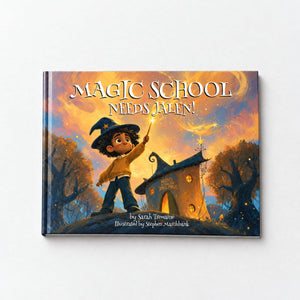
Magic School Needs You!
Ages 4-7The magic school book is for ages 4 to 7 and can suit a child starting school or worrying about mistakes. The school bus drives past your child’s school to a magic school, where your child’s very first spell goes sideways.
Questions
Does a confident child need to feel brave all the time?
No. Confidence can include feeling nervous or unsure. A child can still take a small step, try again, or ask someone for help.
Can a quiet child be confident?
Yes. Confidence does not have to look like speaking first or taking charge. It can be a quiet choice to try, share an idea, or ask for what they need.
What if my child says they cannot do something?
Acknowledge the feeling, then make the next step smaller. You could say, “It feels hard right now. What is one little part we could try together?”
More guides
Make them the hero
Pick a story, add one photo, and see a free preview before you pay.
See all our books