
Picture Books About Empathy for Young Children
Picture books about empathy can help young children pause and imagine what someone else might be feeling or noticing. Read together, talk about different points of view in simple words, and try small activities that connect the story to everyday life.
Why empathy matters in early childhood
Young children are still learning that another person can see the same moment differently. A friend may want a turn with a toy, feel nervous in a new place, or need some quiet. Noticing those feelings gives children more ways to respond than simply reacting.
Stories give children a gentle chance to consider what someone else might know, want, feel, or notice. They can try out an idea without needing to get it exactly right. That practice can make it easier to stay curious about another person during everyday moments, too.
Picture books about empathy can also make it easier to begin a conversation. A character's choice or a change in the scene gives you something concrete to notice together, especially when big ideas like kindness or understanding feel hard to explain.
How to explain another point of view
Use words your child can connect to real life. You might say, “You and your friend saw the same thing, but you each felt something different,” or, “Let's wonder what this might look like to the animal.” These phrases invite your child to think without asking them to know exactly what someone else feels.
For preschoolers and kindergarteners, start with something they can see: a face, a choice, or a change in the scene. Ask what a character might be thinking, and let your child know it is a guess. If they have another idea, listen and look for clues together. Books about empathy for kindergarten children and preschoolers can open up these conversations without making them feel like a lesson.
Picture books about perspective can also help children notice that the same place may seem different to different people or animals. You can keep it simple: “What might they see from over there?” or “What would you notice if you were that small?”
Four ways to practice empathy at home
Keep it playful and brief. Small everyday activities can help your child practice noticing that someone else may have a different experience.
- Look at a familiar place from a new angle. Get low to the floor or look from a window, then ask what seems different from there.
- Choose an animal and wonder what it might notice first in your yard or on a walk. Invite your child to share an idea, even if you do not know the answer.
- When a small disagreement comes up, give each person a turn to say what they wanted. Help your child notice that both people can have real feelings about the same moment.
- Try a “maybe” sentence together: “Maybe they are quiet because they feel shy,” or “Maybe they want a turn.” Remind your child that asking is better than assuming.
Questions to ask after reading
Give your child time to answer, and let the conversation wander. It can feel more like sharing ideas than asking for the right answer if you offer your own wonderings, too.
- What do you think this character noticed first?
- How might the same place feel different to another character?
- What clue in the story makes you think that?
- What question would you ask this character?
- Have you ever felt differently from someone else in the same situation?
A rainforest story about seeing differently
The rainforest book is for ages 4 to 8 and may suit a child who loves rainforest animals or has a lot of questions. It starts when a wise old tree gives your child a wooden lens. Through it, the backyard becomes a rainforest, and your child sees the world the way each animal does.
The story begins with your child's questions, such as “Do worms get tired?” The animal perspectives include a capybara, an ant, a sloth, a chameleon, a tree frog, a jaguar, a macaw, and a toucan, with each animal's way of seeing told in its own short, poem-like passage.
Magikast books are written and illustrated by real people, with the author and illustrator credited on the cover. Your child is brought into the illustrations from one photo, and your child's first name appears in the story. You can see a free preview of the cover, dedication page, and story pages before paying.
Books that fit
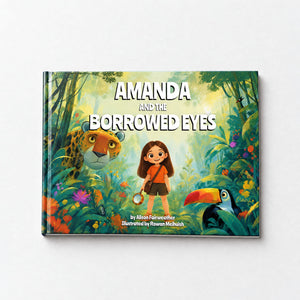
The Borrowed Eyes
Ages 4-8For ages 4 to 8, this rainforest book invites your child to see the world from an animal's point of view. It begins with a wise old tree giving your child a wooden lens, through which the backyard becomes a rainforest. A fitting choice for an animal lover or a child full of questions.
Questions
What if my child has a different idea about what a character feels?
Stay curious and ask what in the story led them to that idea. You can share another possibility without labeling their answer wrong. Looking for clues together helps your child practice considering more than one explanation.
Does my child need to guess a character's feelings correctly?
No. A character's feelings may not be obvious, and children can have different ideas. The useful part is noticing clues, wondering what might be going on, and being open to asking rather than assuming.
What if my child does not want to talk after reading?
Let the conversation rest. You can share one thing you noticed, or return to the story another time. Children can take in an idea without having an answer ready right away.
More guides
Make them the hero
Pick a story, add one photo, and see a free preview before you pay.
See all our books